



SpeechGears India
Horn Kit
Horn Kit
Couldn't load pickup availability
The SpeechGears Horn Kit represents a new generation of oral sensory motor tools that seamlessly integrate sensory biofeedback, acoustic control, and muscle engagement to support evidence-based intervention. Developed by SpeechGears Pvt. Ltd., this innovative tool is designed for clinicians, educators, and caregivers working with individuals across the lifespan ranging from children developing foundational speech skills to adults recovering from speech or swallowing challenges. Grounded in the principles of Oral Sensorimotor Integration Therapy (OSIT), the Horn Kit emphasizes the importance of tactile-kinesthetic feedback and motor learning to create lasting, functional outcomes. Each horn within the kit is engineered with precision to address specific oral motor and speech-sound goals. Through controlled exhalation, graded lip closure, and coordinated abdominal support, users strengthen the physiological foundations necessary for clear articulation, resonance control, and stable feeding patterns.
The kit features 10 progressive horns, each carefully designed to build upon the previous level. This structured hierarchy allows users to advance step by step from basic airflow control to more complex speech and respiratory coordination. Whether used in clinical sessions, classroom settings, or home programs, the Horn Kit transforms traditional therapy into an engaging, play-based experience that motivates clients while delivering measurable progress. By combining evidence-based design with user-friendly tools, the SpeechGears Horn Kit empowers therapists to create personalized, effective, and enjoyable interventions. It stands as a bridge between traditional oral motor exercises and modern therapeutic technology helping individuals achieve improved speech clarity, enhanced oral–motor function, and greater communication confidence.
The SpeechGears Horn Kit is a uniquely designed oral sensory and motor therapy tool developed to help individuals improve speech, swallowing, and feeding abilities through structured, play-based exercises. Grounded in the principles of Oral Sensorimotor Integration Therapy (OSIT), the kit integrates evidence-based strategies that emphasize tactile-kinesthetic feedback and motor learning for long-term, functional improvement. The approach reflects the idea that consistent and purposeful motor practice enhances speech intelligibility and oral control (Maas et al., 2008; Strand, 2011). The kit includes 10 color-coded horns, each featuring different resistance levels and aerodynamic designs. These horns are arranged in a progressive hierarchy to support the gradual development of essential oral-motor functions such as abdominal grading, oral airflow control, lip closure, and velopharyngeal function. Therapy typically begins with basic level, which focuses on establishing basic airflow and breath support, and advances through higher levels that target precise lip, jaw, and tongue coordination. This structured progression follows motor learning principles, encouraging repetition, feedback, and gradual complexity to facilitate lasting motor patterns (Guenther, 2006; Clark, 2010).
By normalizing oral musculature, the SpeechGears Horn Kit helps clinicians achieve measurable gains in articulation precision, controlled airflow, breath support, phonation control, reduction of drooling, improved oral-sensory awareness, and better self-monitoring. It also enhances jaw–lip–tongue association, abdominal grading, and tongue–lip placement all contributing to improved speech clarity and stability. These benefits are consistent with research suggesting that targeted oral-motor interventions, when paired with speech-based tasks, can improve articulatory accuracy and oral coordination (Bahr, 2018; Hayden & Square, 2017). The SpeechGears Horn Kit aligns with traditional oral-motor hierarchies but extends their potential by introducing structured levels and opportunities for real-time sensory biofeedback. This combination of tactile input and controlled resistance engages the respiratory and articulatory systems, helping clients experience immediate feedback on their performance. Such sensory engagement enhances cortical motor planning and supports generalization to speech production (Rosenfeld-Johnson, 2019; Guenther, 2016).
Each therapy session incorporates visual and auditory cues, such as mirrors and modeling, to reinforce correct movement patterns. Consistent practice should be recorded in a therapy log to monitor progress in oral-motor control, speech clarity, and overall coordination. For hygiene and safety, all horns—except the CITI horn must be hand-washed with warm water and mild soap, as they are not dishwasher safe. Blowing emerges from 2 years of age. The kit is not recommended for children under 2 years of age, and all sessions must be supervised by an adult or qualified professional. When used consistently and under the guidance of a speech-language pathologist, the SpeechGears Horn Kit offers an engaging, structured, and scientifically grounded method for improving vital communication and feeding skills. It combines traditional oral-motor exercise principles with modern feedback-based therapy to create an effective, interactive, and motivational experience that bridges the gap between play and purposeful motor development.
Structure
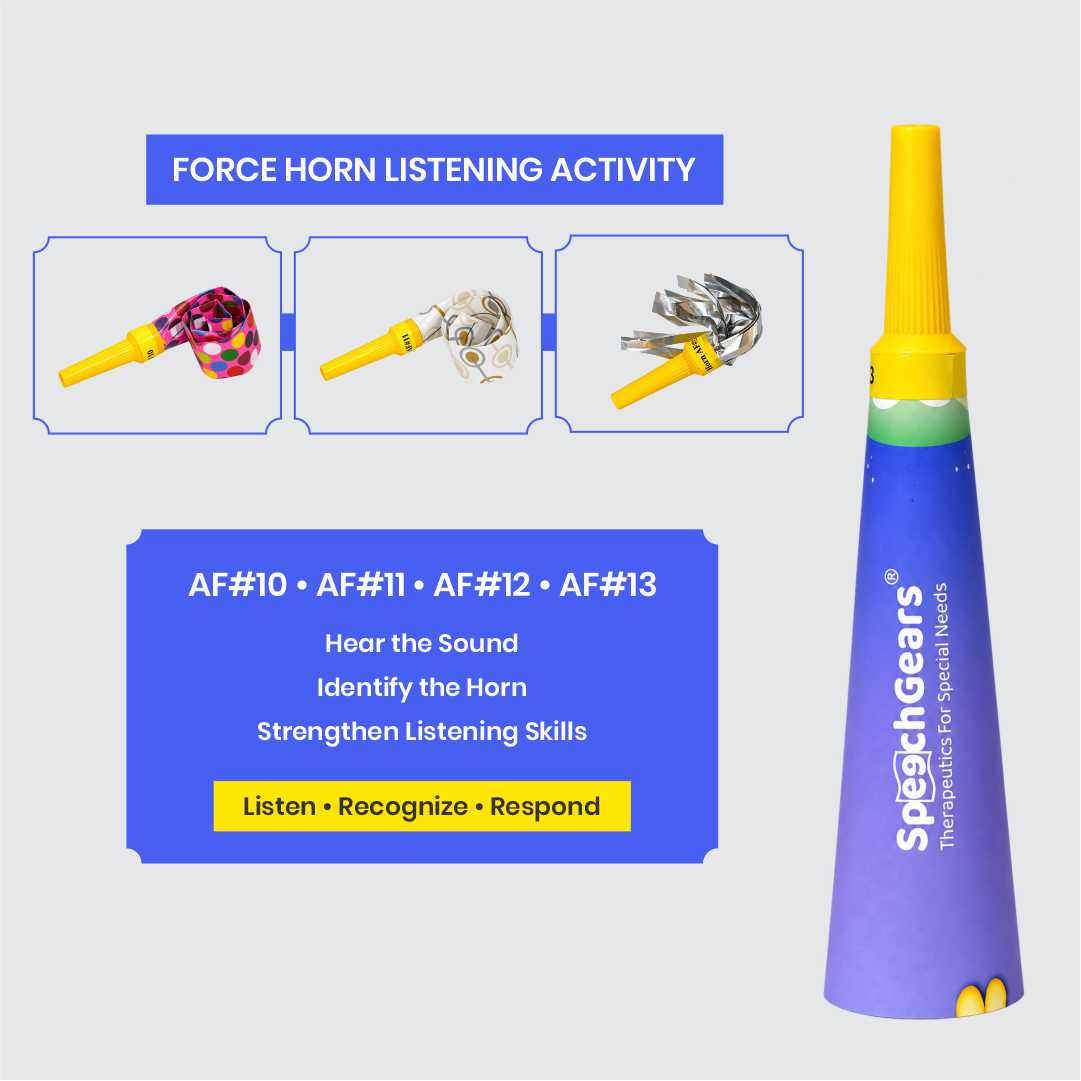
The SpeechGears Horn Kit contains three progressive levels totaling ten horns. Eachlevel increases in complexity, requiring greater control of airflow, lip tension, and jaw stability.

Developmental Progression and Age Ranges
SpeechGears horns can be used with clients as young as 2 years and as old as 70 years.However, specific horns correspond to developmental or rehabilitative stages:
•Level 1 (CITI horns): Early intervention, 2 years – 4 years; ideal for toddlers with drooling or low tone.
•Level 2 (Jet horns): School-age children (5–10 years) and adolescents refining resonance and vowel clarity.
•Level 3 (Force horns): Older children (10+), adults in neurorehabilitation (e.g., post-stroke, Parkinson’s), and individuals with advanced articulation or motor-planning needs.
Guidelines for Therapy Sessions
1. Positioning
Stabilization in the body allows mobility in the mouth. Maintain 90° angles at the pel-vis, knees, and ankles whether the client is seated or supported in adaptive equipment.
2. Session Structure
•Warm-up: brief breathing or oral-sensory stimulation.
•Target horn practice: 25 repetitions with controlled exhalation.
•Rest interval: short pauses between sets to prevent fatigue.
•Feedback discussion: visual review of biofeedback light or acoustic pattern.
•Home practice: assigned repetition count, supported by caregivers.
3. Repetition and Progression
•25 successful, consecutive horn activations.
•Once achieved, progress to the next horn or increase endurance targets.
4. Caregiver Involvement
Caregivers play a vital motivational role. Daily short home practice accelerates progress and fosters parent child interaction.
Safety, Care, and Maintenance
Clean horns manually with warm, soapy water; not dishwasher safe except Level 1 horn- CITI Horn
•Ensure horns are fully dry before storage.
•Replace damaged mouthpieces immediately.
•Do not allow unsupervised use; prevent biting or chewing.
Description
Description
Materials
Materials
Food Grade Material
Dimensions
Dimensions
× ×
Warranty
Warranty